
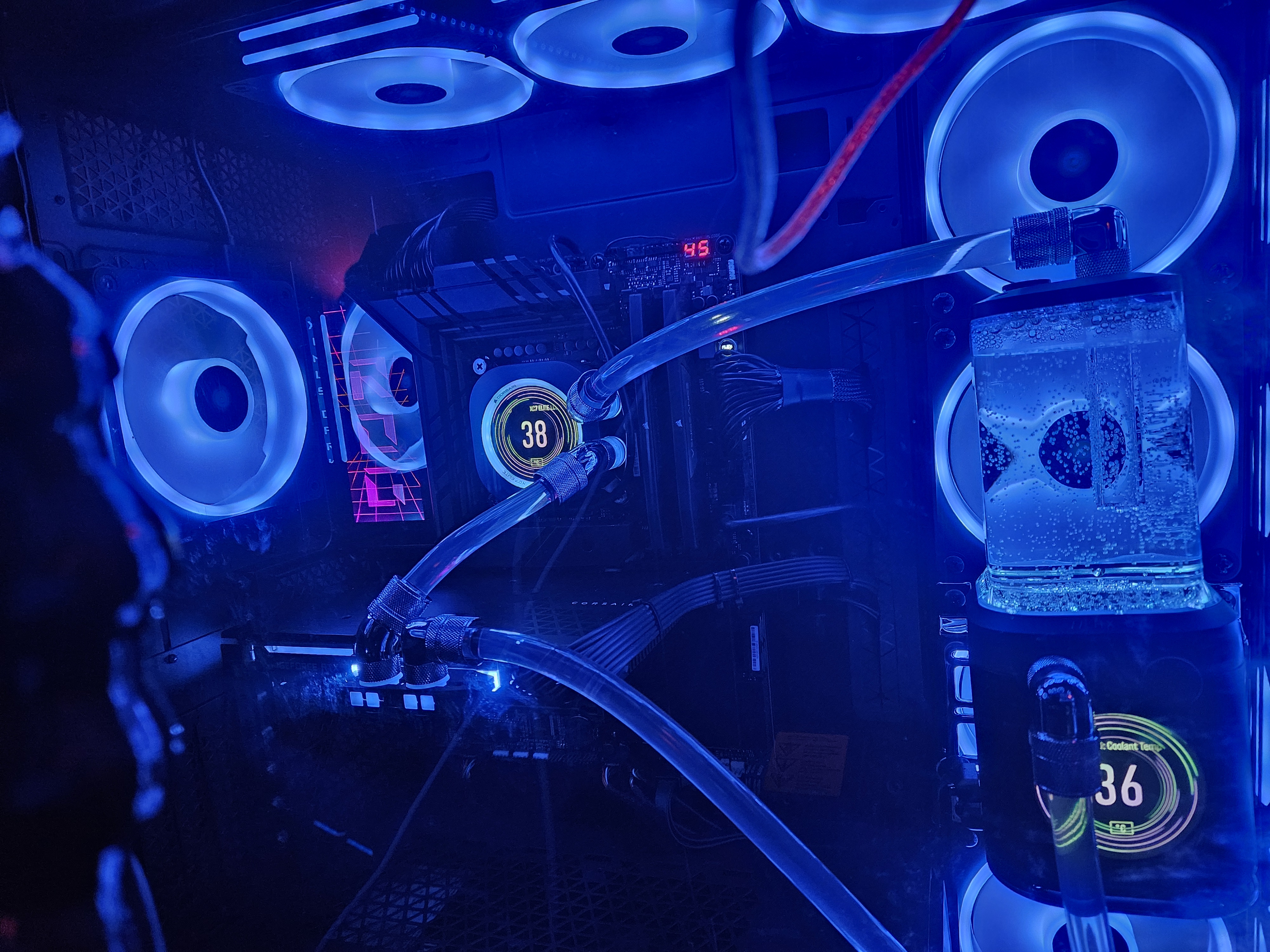
I am a sim racer and professional content creator. After nearly four years of (mostly) successful racing, my 9th Generation Intel processor and its trusty companion Nvidia 2080 Super were beginning to fail under the constant strain of driving triple 1440p monitors while at the same time recording video content for various business and personal projects. In early 2023, I began quietly looking for a suitable upgrade path.
Like most technical professionals, I can build PCs from the ground-up using individually sourced components. There is joy to be found in such an exercise, but it comes with some serious downsides. In the business world, it is an approach that does not usually scale beyond a handful of employees due to the time and effort needed to build PCs that is best allocated to running the business. In the personal world, it is much more approachable (especially for hobbyists), but the downsides become clear if anything goes wrong; one has to keep warranty information and manage any required Return Merchandise Authorizations for each individual failed part rather than having just “one throat to choke” in a builder or manufacturer. Given my busy life, I made the safe choice to seek a system integrator with a good reputation and the ability to build to the hardware specifications that met my expanding sim racing and video production needs. Or so I thought (note the ominous foreshadowing here).
After doing my due diligence reading articles, watching in-depth video reviews by trusted industry experts, and exploring a dizzying amount of technical specifications, I finally settled on OriginPC as my systems integrator, and settled on a custom build of one of their GENESIS systems sporting a high-end 13th Generation Intel processor, 32 GB of DDR5 RAM, and an Nvidia 4090 graphics card. All of this sitting upon an ASUS ROG MAXIMUS Z790 HERO motherboard, with the processor and graphics card directly cooled by Corsair‘s Hydro-X water-cooling system. Stout specifications by almost any measure. I placed the order in mid-March, and after waiting almost a month, an impressive 30″ x 27″ x 18″ wooden crate arrived at my doorstep (I kept the crate, and use it for storage…my dogs love it).

Life was good and I was happy. While the heat output was ridiculous under full load, the performance was staggering. The new PC did everything I needed and more. I had no complaints.

No complaints, that is, until a sudden and unexpected “black screen” crash occurred in early January, 2024 (8 months after receiving the PC) while qualifying for a race for which I had been preparing for over a month. One computer crash, no big deal. But the crashes kept coming, one after another, in quick succession until I had no choice but to abandon the race.
As an IT and security professional, I am fastidious about maintaining my system; BIOS, hardware drivers, operating system, and software are always kept up-to-date, for both security and performance reasons. My first thought was that a recent update had somehow introduced a bug, which is not unheard of, and is usually no big deal. I made a plan, and I followed it…trying to get to the bottom of the issue.
Over the next 3 days, I was able to reproduce the crash over-and-over as I went through diagnostic activities to try to identify its cause (see a truncated summary of steps taken below).
- Disconnected all peripherals (except monitors) and reproduced the crash, pointing to a software or hardware issue with the PC itself.
- Updated BIOS to the latest version.
- Updated Intel chipset driver to the latest version.
- Reinstalled entire suite of the latest hardware drivers.
- Turned-off all XMP settings for memory.
- Tested the memory.
- Tested the SSD drives.
- Examined the minidump from one of the crashes with WinDbg; it pointed to nvlddmkm as the offending module; suggesting the issue was a corrupted video driver.
- Turned off Windows Update Hardware Driver Install.
- Turned off Windows Fast Startup.
- In Windows Safe Mode, extracted and ran DDU to cleanly and completely remove the NVIDIA driver.
- After reboot, installed the latest version of the NVIDIA Studio Driver (supposedly more stable than the Game Ready branch I had been running). Under load, reproduced the crash again multiple times.
- Used DDU to cleanly and completely remove the video driver again, and then installed the prior known stable version.
- Continued reproducing the same crash multiple times under load, each time with nvlddmkm being reported as the offending module that was causing the crash.
I finally concluded that the issue must be rooted in a hardware fault of the NVIDIA 4090 graphics card. I reached out to OriginPC Support with all the details related to the crash, the diagnostics I had performed, and what my conclusions were. They could not (would not) simply give me a replacement graphics card due to the complexities around warranties should the customer (me) be made responsible for draining/refilling of the water-cooling system; they needed to send me shipping material, and I had to return the entire PC to them for resolution.
In short, the original failure occurred on January 7. I finished my diagnosis and testing on January 11 and opened a ticket with OriginPC. I received return shipping material from them on January 18 and shipped the PC to them that same day. They received it on January 26 (according to UPS). They finally marked it as received on January 29, and notified me by email. Then silence. On February 16, after my inquiries into the almost three weeks of no updates, they broke the news (suspiciously) that the PC had arrived damaged, and that they had generated an order for a new build. Then another two weeks of silence. According to a system generated email, the build went into integration (testing) on March 1. Then yet another two weeks of silence. In response to another inquiry, on March 15, they informed me of a bench failure during testing. On March 18, I got an update indicating the build had been “escalated” to management. Then silence again until March 26 when I was notified the new system was shipping, and would arrive March 28. After over two months, and huge amount of poor communication, my bet on the value of a systems integrator finally paid-off.
I still do not have a clear understanding of what failed on the original PC, or why. It also remains a mystery why they were not able to remediate the situation more quickly, or keep an acceptable level of communication with me, their customer, throughout. I know that OriginPC was acquired by Corsair in July of 2019, and is maintained as a separate brand. Whether or not that had an impact on the volume of work in the OriginPC Miami facilities, the ability of their staff to manage unexpected workflows, or in their overall priorities I can’t say. It is important to note that, hardware failures around the 13th and 14th Generation Intel processors and the Nvidia 4090 graphics card are not unheard of, so the failure I experienced was probably to no direct fault of OriginPC…though the customer experience when dealing with support is 100% their responsibility, and this experience was not, on the whole, a positive one for me.
It would be unfair of me not to acknowledge that the computer OriginPC provided as a replacement for my failed hardware was better than the one I originally ordered. I suspect that may have been a direct result of parts availability (or lack thereof), but I don’t know for sure. That could have also been the reason it took so long and demanded escalation to management. I do know that my original 13th Generation Intel processor was upgraded to a 14th Generation processor, 32 GB of DDR5 RAM became 64 GB of DDR5 RAM, and the Hydro-X water-cooling loop came equipped with LCD temperature read-outs for both the CPU and the water reservoir. Worth the wait? I’ll let you know next January.

As I reflected on this topic before beginning to write, I was taken back many years in my career to a very bad experience with a value-added reseller and computer manufacturer (both to stay nameless at this point, given it would not be fair to throw either of them under the bus after so many years) wherein we had over 70% of the high-end PCs in a large order arrive DOA with terminal hardware issues. Neither the VAR or manufacturer were willing (or able) to make it right. We wound up eating the cost (staff time and money) to correct the issues ourselves to deliver critically needed computers to users. A bad time for all…far worse, in terms of outcome, than my dissatisfaction with my chosen systems integrator.
Things are not nearly so dark these days…at least not in my recent experience. Also, to be clear, I’m not advocating for everyone to start building their own PCs now. As stated before, especially for business, that almost never makes sense. That being said, to deliver on their true promise, systems integrators (and VARs…and manufacturers) must start to view their customers as critical assets for their continued success; just as valuable as the revenue those customers represent, if not more so. Luckily, making customers happy just involves consistent communication, prompt follow-through on issues, and doing what they say they are going to do. You know, doing the right thing. As my Mom used to say, ‘Get the easy stuff right, and the hard stuff becomes manageable.’ She was pretty smart.


Please share your thoughts.